Selling guide
How to Sell Perler Bead Art on Etsy (and Beyond)
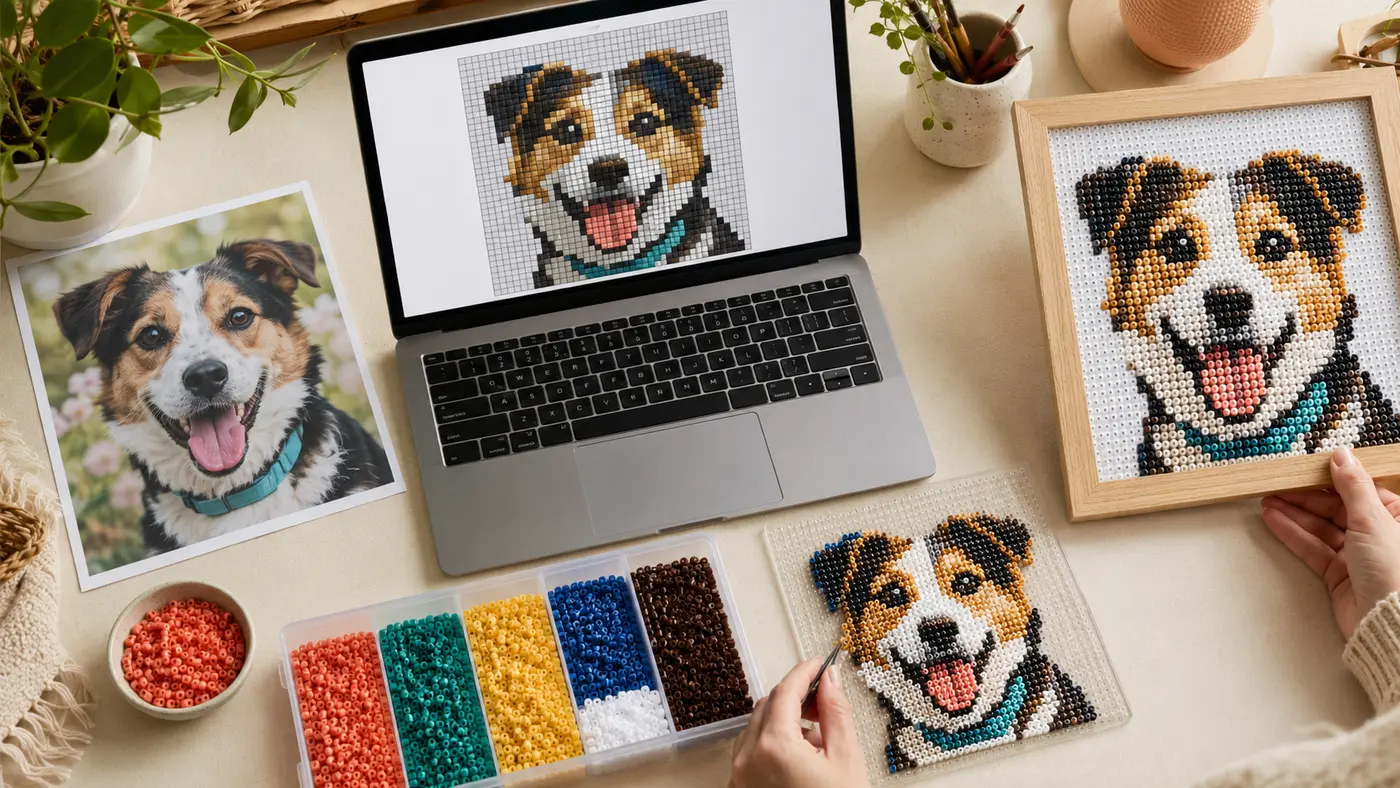
Yes—you can build a real made-to-order business around custom fuse bead art. The clearest offer is simple: a buyer sends a favorite photo, you translate it into a buildable bead pattern, then you make and ship a physical portrait. Pets are an especially practical starting niche, but the same workflow works for couples, families, houses, memorials, original avatars, and authorized business logos.
This guide covers the whole path from choosing an offer to pricing, Etsy setup, photo intake, BeadForge production, listing SEO, intellectual property, photography, packaging, and expansion to other marketplaces. It is written for someone who wants a repeatable business—not merely one lucky sale.
The short version
Start with one narrow offer: custom pet portrait fuse bead wall art from a customer photo. Create three clear sizes, require a usable image, price from your actual costs and time, include a limited proof policy, and photograph one excellent sample. Use BeadForge to standardize the crop, palette, pegboard layout, bead count, blueprint, and build progress for every order.
Is fuse bead art a good product to sell?
Fuse bead art has several useful business qualities: the material is colorful and recognizable, the making process is satisfying to watch, designs can be personalized, and a finished piece is easy to understand as a gift. Etsy already has active result pages for custom bead portraits, pet patterns, magnets, keychains, finished wall pieces, and DIY kits. That demonstrates shopper interest, but it also means a generic “I make anything” listing has little reason to win the click.
A stronger offer connects one buyer, one occasion, and one deliverable. “Custom 8-inch pet portrait made from your photo” is clearer than “custom Perler art.” The buyer immediately understands whom it is for, what they send, what arrives, and why it is more meaningful than a mass-produced decoration.
Five product models you can test
| Offer | Why a buyer chooses it | Operational reality |
|---|---|---|
| Custom pet portrait | Birthdays, memorials, new-pet gifts, and personal home décor | Strong photo-based offer; set firm size, background, proof, and revision rules. |
| Couple or family portrait | Wedding, anniversary, Mother’s Day, Father’s Day, or housewarming gift | Higher detail and more faces usually require more boards, colors, time, and proofing. |
| Magnet, keychain, or ornament | Lower-cost personalized keepsake that is easy to gift | Good add-on, but attachment strength and small-pattern readability need testing. |
| Custom digital pattern | The customer wants to build the portrait themselves | No physical shipping, but instructions, file delivery, originality, and support still take time. |
| DIY kit | A guided craft experience with the correct colors already gathered | Can raise order value, while increasing sorting, labeling, inventory, packaging, and safety duties. |
Begin with the product you can produce consistently, not the one with the largest possible canvas. One beautiful, repeatable size is better than six confusing options. Add variations only after real orders show which dimensions and finishes buyers request.
Build a custom photo-to-bead-art offer
Write the operating rules before creating the listing. This protects your time and makes the buyer more confident. Define the final dimensions, included subject count, background treatment, frame or mounting choice, display-side melt, revision allowance, processing window, shipping regions, and what happens when a submitted photo cannot produce a good pattern.
- Subject: one dog or cat per portrait is the easiest first offer.
- Input: one sharp, well-lit original photo with the face unobstructed.
- Style: a recognizable pixel-art interpretation, not a photorealistic print.
- Size: list both physical dimensions and pegboard dimensions.
- Finish: specify framed, mounted, freestanding, magnet-backed, or unmounted.
- Proof: state whether a digital pattern preview is included and how many changes it permits.
- Turnaround: separate your making time from the carrier’s delivery estimate.
- Permission: require the buyer to confirm the right to use the supplied photo or logo.
Set expectations in plain language
Fuse beads have a fixed grid and a limited physical palette. Your colors will be selected from real bead references, but screen color, room light, dye lots, and photography can all change how a shade appears. Describe the product as a handmade pixel interpretation and show close-up photos of the bead texture.
How to use BeadForge for a paid custom order
The goal is not to press one button and accept whatever appears. Your value as the maker is choosing the right crop, size, colors, finish, and corrections so the physical piece reads clearly. BeadForge turns those decisions into a repeatable production file.
- Qualify the photo. Look for a sharp face, visible eyes, directional light, and separation between the subject and background. Ask for the original file instead of a social-media screenshot.
- Choose the physical size first. Set the number of pegboards before refining detail. A more complex subject needs more bead positions; promising a tiny portrait before testing the image invites disappointment.
- Select the bead brand you will actually use. Keep Perler, Hama, Artkal, and Nabbi palettes separate unless you have physically tested a mixture. A screen match does not guarantee the same melt behavior.
- Crop and simplify. Center the most recognizable features, remove or flatten a distracting background, and use brightness, contrast, and saturation carefully. More detail is not always more readable.
- Restrict the palette to your inventory. Use only the colors you own or can reliably replace. This prevents a proof from depending on a shade that is unavailable when the order is due.
- Inspect the grid, not only the preview. Check eyes, mouth, silhouette, shadows, isolated pixels, fragile one-bead bridges, and board seams. Edit or resize before promising the result.
- Save the production information. Use exact per-color counts to pull materials and add a small waste allowance. Export the printable pattern and keep the approved version with the order record.
- Build methodically. Craft Mode lets you track progress board by board. Perform a final row-by-row check, then fuse, cool, finish, photograph, and pack the piece.
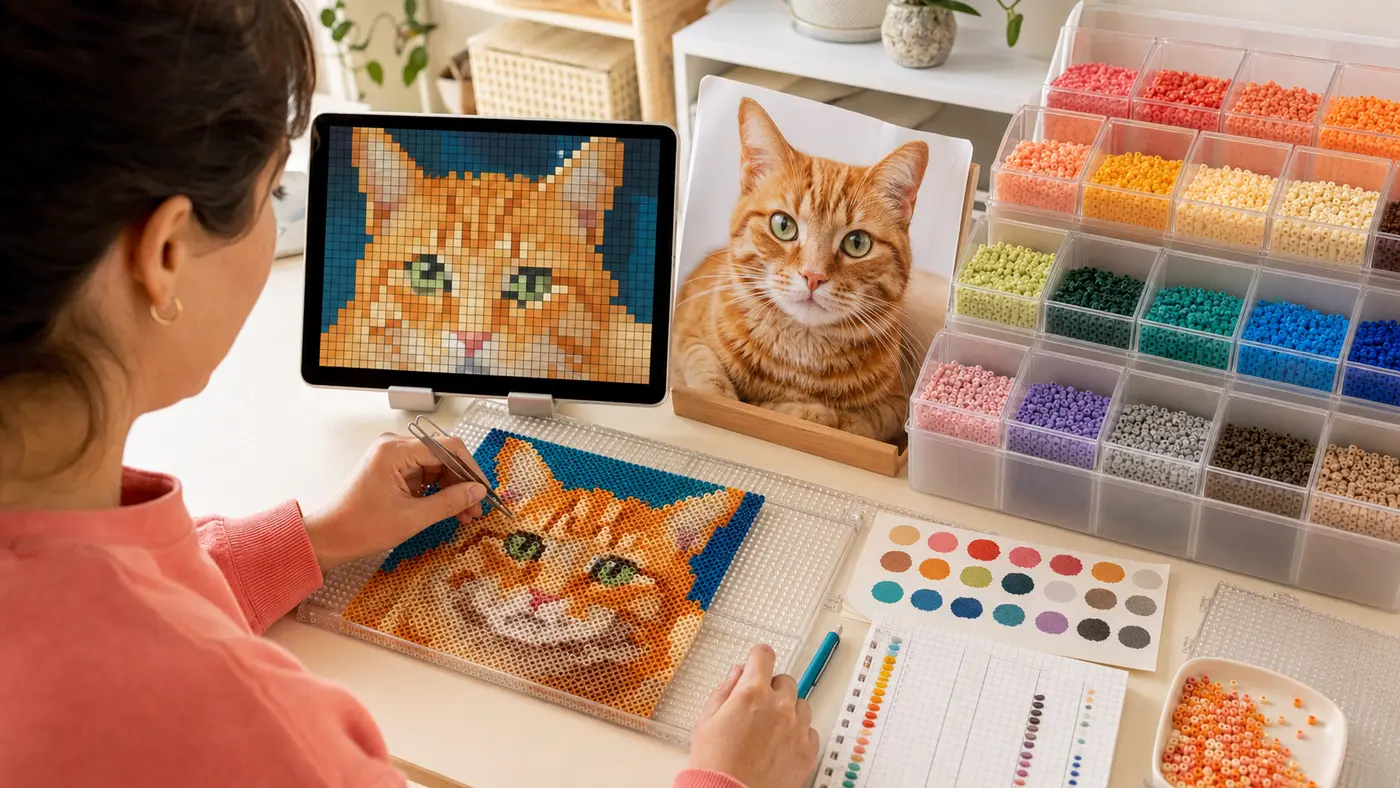
Upload a photo, choose the physical palette and board size, simplify the background, review exact bead counts, and create a production-ready pattern before you quote the order.
Plan a customer portraitFor a deeper conversion walkthrough, read how to turn a photo into a Perler bead pattern. For commissions centered on people, dogs, or cats, the portrait-from-photo guide covers feature cleanup, grid size, palette control, proof checks, and large-project planning. The photo-selection guide explains why some reference images survive a small grid better than others, and the pegboard planner helps translate board count into a final physical footprint.
A repeatable Etsy order workflow
- The buyer chooses a size and finish. Use variations for options that genuinely change price, dimensions, processing time, or hardware.
- The buyer uploads the reference. Etsy’s current personalized-listing tools can collect a file, text, or option choice. Ask for permission, subject name, crop preference, and deadline.
- You review before production. Confirm that the image is usable. If not, request alternatives before starting the processing clock promised in your policy.
- You create and check the pattern. Run the BeadForge workflow, verify inventory, estimate labor, and prepare the proof if the product includes one.
- The buyer approves within the stated boundary. Keep approval and requested changes in the marketplace message thread. Do not offer unlimited revisions.
- You make the final piece. Follow the approved pattern, count, fuse, cool, mount, and inspect it. Save a photo of the completed order before packaging.
- You protect and ship it. Immobilize the piece, use rigid support, upload tracking when appropriate, and send concise care or display instructions.
Etsy’s official instructions explain how to enable personalized listing fields and a shop-wide Request Custom Order button. Use the personalized listing for a defined product and the custom-order button for work that needs a private quote.
How to price custom fuse bead art
Bead count is a material measure, not a complete price. Two 2,000-bead portraits can require very different pattern cleanup, color sorting, messages, fusing, framing, and packaging. Record the actual time for your first five samples and orders; memory almost always forgets the small tasks.
| Cost bucket | What belongs in it | How BeadForge helps |
|---|---|---|
| Materials | Beads, frame, backing, adhesive, hanging hardware, magnets, ironing paper, and waste | Exact per-color counts make the bead portion measurable before you accept the order. |
| Labor | Photo review, messages, pattern cleanup, proofing, sorting, placing, fusing, finishing, photos, and packing | Reusable settings, a printable blueprint, and Craft Mode reduce avoidable production time. |
| Packaging and shipping | Surface protection, rigid board, corner guards, padding, box, label, insurance, and postage | Known final board dimensions help you choose packaging before listing the size. |
| Overhead | Tools, damaged boards, replacement irons, lighting, workspace, software, insurance, and bookkeeping | Track this outside each pattern and allocate a consistent amount per order. |
| Selling costs | Listing, transaction, payment, advertising, currency, and platform-specific fees | Use the current fee page for the channel; do not copy an old percentage from a blog. |
A pricing formula that protects your pay
First calculate your target subtotal: materials + packaging + labor + overhead + desired business profit. Then account for percentage-based selling costs:
Pricing formula
Minimum listing price = target subtotal ÷ (1 − estimated variable-fee rate)
Example: suppose beads and finishing materials cost $20, protective packaging costs $5, three hours of labor at $18 per hour equals $54, and your overhead plus business-profit reserve is $11. The target subtotal is $90. With a hypothetical 10% variable-fee planning rate, $90 ÷ 0.90 = $100. Shipping is then charged separately or added to the subtotal before the calculation if you advertise it as included. This example teaches the math; it is not a recommended market price or Etsy fee quote.
Etsy currently separates listing, transaction, payment-processing, advertising, and other possible charges. Because rates and eligibility can change, use Etsy’s live fees and taxes page when building your spreadsheet. Recheck the math whenever you change size, frame, shipping method, or marketplace.
Use the companion complete fuse bead art pricing and profit guide for cost-per-bead math, labor tracking, margin versus markup, a worked portrait example, wholesale planning, and the quote-to-profit review checklist.
Quote before you promise
Save the customer’s approved pattern as a private project, record the exact bead count and finished dimensions, and put the quoted price and processing window in writing before production. If the crop, frame, board count, or background changes after approval, re-run the cost and delivery calculation; that is a scope change, not free cleanup.
Create an Etsy listing that earns the click
Etsy says its search system considers the complete listing, including titles, tags, attributes, descriptions, the first photo, reviews, and other signals. Relevance gets you into the right search; a clear offer, strong first image, transparent process, realistic delivery date, and good customer experience help turn that appearance into a sale.
Sample title
Use a readable title, not a keyword wall
Custom Pet Portrait in Fuse Beads, Personalized Pixel Art from Your Photo, Handmade Dog or Cat Gift
Lead with the product a shopper recognizes. Use “Perler bead” only when it truthfully describes the brand of beads in the piece; use “fuse bead art” and “pixel art portrait” as accurate broader language.
Thirteen starter tag ideas
Adapt these to the exact product instead of pasting unrelated phrases: custom pet portrait, fuse bead art, pixel pet portrait, dog memorial gift, cat lover gift, handmade wall art, photo to pixel art, custom dog portrait, personalized gift, bead art portrait, pet loss gift, gamer room decor, and unique pet gift. Etsy’s current guidance recommends using all 13 tag opportunities, favoring varied multi-word phrases and completing relevant categories and attributes.
Answer these questions in the description
- What exactly will arrive: a finished physical piece, a digital pattern, or a DIY kit?
- What are the dimensions in inches or centimeters, and is a frame included?
- How many subjects are included, and what costs extra?
- What kind of photo should the buyer upload?
- Is the background removed, simplified, or reproduced?
- Does the buyer receive a proof, and how many revisions are included?
- What natural handmade and screen-to-bead color variations should they expect?
- How long does production take before shipping?
- How is the piece mounted, displayed, cleaned, and protected?
- What permission must the buyer have for a submitted photo, artwork, or logo?
Review Etsy’s own explanations of how Etsy search works and its shop optimization checklist before publishing. Search guidance evolves, so the marketplace’s current documentation should outrank any fixed list of hacks.
Photograph the texture, scale, and process
A buyer cannot touch the piece, so your images must do three jobs: make the product desirable, prove it is handmade, and remove uncertainty. Use soft window light or diffused lamps, a neutral background, a steady camera, and consistent white balance. Avoid filters that make the bead colors look more saturated than the physical order.
- Lead with the finished portrait filling most of the frame.
- Show a straight-on view plus an angled close-up where individual fused beads are visible.
- Include a hand, ruler, shelf, or wall scene that communicates scale.
- Show the back, frame depth, hanger, magnet, keychain, or mounting method.
- Use one process image of the approved grid beside the in-progress pegboard.
- Show packaging so the buyer understands how the art will be protected.
- Add a short placement or fusing video if it accurately represents the item being sold.
Never publish a customer’s private reference photo, child’s portrait, family image, name, address, or message without clear permission. You can still photograph the finished piece for order records; obtain a separate opt-in before using it in a public listing, portfolio, pin, or video.
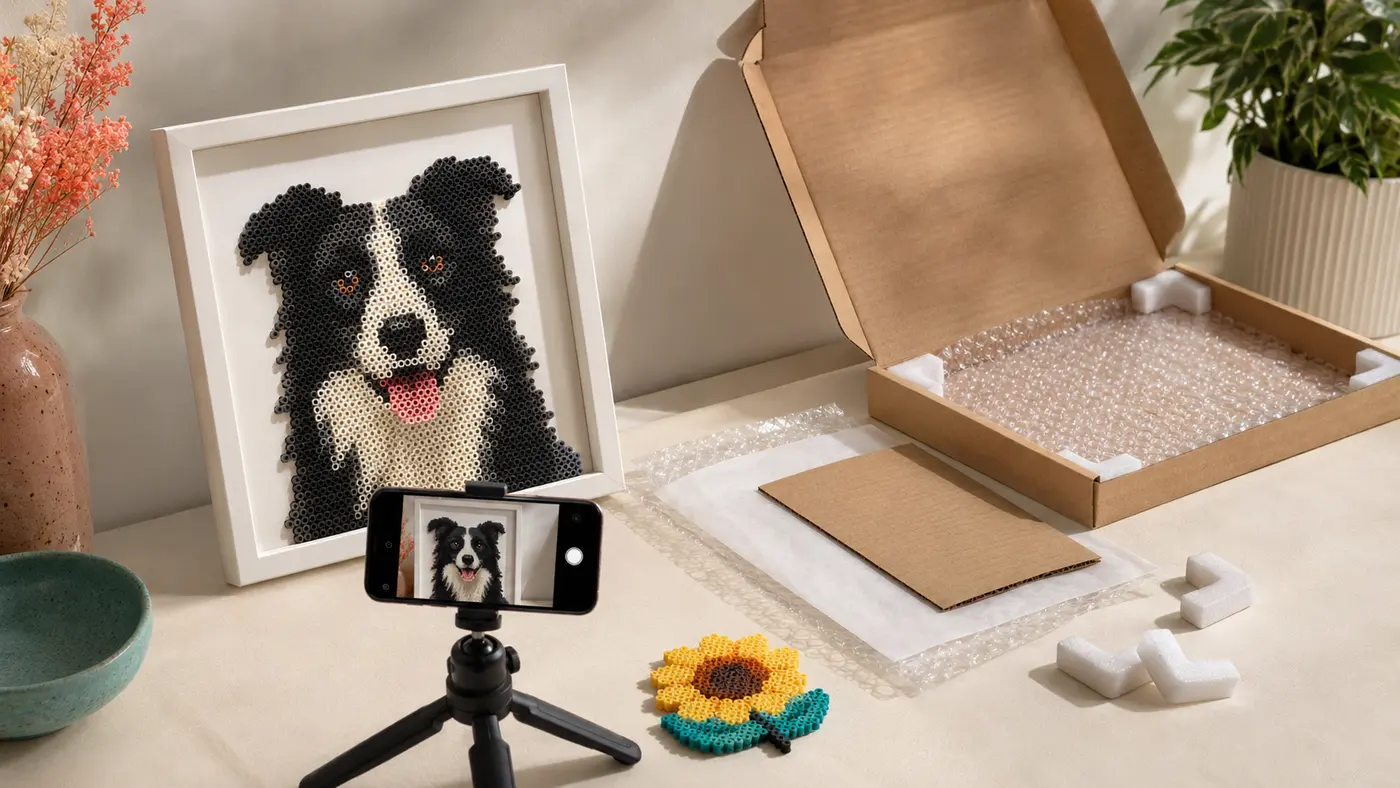
How to package and ship fuse bead art
The two shipping enemies are bending and movement. A padded mailer alone may cushion impact but still let a flat piece flex. The exact method depends on whether the art is loose, mounted, or framed, so build and test a complete sample package before setting the shipping price.
- Cool the piece completely and inspect seams, edges, hardware, and frame attachment.
- Place a clean, nonabrasive protective sheet against the face of the artwork.
- Sandwich an unframed piece between rigid boards larger than the design.
- Protect frame corners and keep the face away from direct pressure.
- Wrap the assembly so it cannot slide, then center it inside a crush-resistant box.
- Fill voids without forcing the frame or bead surface into a curve.
- Seal, label, weigh, and measure the real package—not an estimate based only on the artwork.
- Test one sample package for a short drop, edge impact, compression, and attempted bend.
Photograph the completed item and the sealed package before handoff. For high-value work, compare tracking, insurance, signature, and claim requirements. International orders add customs, product-safety, and destination rules; begin domestically if you have not built that process yet.
Copyright, characters, logos, and customer photos
“I made it by hand” and “I changed it into pixels” do not automatically grant permission to sell someone else’s art, photograph, character, game sprite, movie image, team logo, or brand mark. The U.S. Copyright Office explains that copyright can protect photographs and visual art from the moment they are fixed, and that only the rights owner can authorize a derivative version. Etsy also maintains a formal intellectual property reporting process.
- Create original designs and photograph your own samples.
- Use customer-supplied personal photos only with their confirmation that they have the necessary rights.
- Get written permission before accepting a company logo or artwork owned by another person.
- Do not copy another maker’s pattern, listing photos, wording, or finished design.
- Do not treat the presence of similar fan art in search as proof that it is licensed or safe to sell.
- Describe bead brands accurately without implying that your shop is the manufacturer or an official partner.
Read Etsy’s current Creativity Standards and Intellectual Property Policy, plus the U.S. Copyright Office’s visual artist overview. This section is general education, not legal advice; ask a qualified attorney about a specific license or dispute.
Etsy alternatives for selling bead art
| Channel | Best use | Main tradeoff |
|---|---|---|
| Etsy | Testing custom-gift demand inside an established handmade marketplace | Competition, marketplace rules, and several possible fee types; the customer relationship stays platform-centered. |
| Your own Shopify store | Building a distinct brand, email list, bundles, content, and long-term customer value | You control the storefront but must create the traffic and maintain the selling system. |
| eBay | One-off finished pieces, collectibles, auctions, and buyers already comfortable with marketplace shipping | Category-dependent fees and a shopping environment that can be more price-comparison oriented. |
| Amazon Handmade | Reaching Amazon shoppers after your handmade application is approved | More operational requirements and marketplace dependence; verify current plan and referral-fee terms. |
| Local fairs and markets | Testing prices face to face, selling ready-made minis, and taking portrait deposits | Booth fees, travel, weather, local demand, display equipment, and limited event dates. |
| Social media plus invoices or a store | Showing time-lapses, before-and-after transformations, and taking audience-led commissions | Reach can be inconsistent; use a secure checkout and written order terms instead of informal payment messages. |
Marketplace fees change, so compare each channel using its official pages before setting a price. See the current seller information for eBay fees and Amazon Handmade. A sensible path is Etsy for demand validation, local events for direct feedback, and an owned store when repeat customers and organic traffic justify it.
Turn one commission into a content engine
A custom order naturally produces useful marketing material: the reference problem, crop decision, color palette, pattern reveal, bead placement, fuse, finished portrait, packaging, and customer reaction. With permission, one order can support several pieces of content without reposting the same sales image.
- A short vertical time-lapse from empty boards to finished art.
- A Pinterest pin comparing the authorized source photo, bead-grid preview, and final piece.
- A close-up post explaining why a certain portrait needed more boards or fewer background colors.
- A blog answer to a real buyer question such as sizing, photo quality, care, or memorial-gift timing.
- An email or social post showing a new frame, magnet, ornament, or size option.
- A local portfolio page for custom pet portraits and pickup commissions in your service area.
Lead every piece of content to one focused product page. Do not send a pet-portrait shopper to a homepage and make them search. Use consistent language—custom pet portrait, fuse bead art, personalized pixel art, and made from your photo—only where each phrase describes the real offer.
Your first-sale launch checklist
- Choose one niche, one format, and no more than three sizes.
- Create and time at least three original samples using different photo conditions.
- Record material use, production time, failure rate, package dimensions, and shipping weight.
- Write the price formula and margin floor before seeing competitor prices.
- Create the listing photos, short video, title, tags, description, options, FAQ, and policies.
- Test the photo-upload and order-message flow from a buyer’s point of view.
- Build one complete mock order, including proof, production record, packing, and tracking.
- Publish, then share a process video and one search-focused pin that links directly to the listing.
- Review visits, favorites, questions, conversion, production time, and profit after every five orders.
- Expand only the part buyers repeatedly request: another size, subject count, finish, or product type.
The business advantage
BeadForge makes the invisible planning work repeatable. The buyer is paying for your judgment, craftsmanship, communication, and finished object; the software helps you quote with a real board size, buy from an exact material list, reproduce the approved pattern, and spend less time correcting avoidable mistakes.
Sources and review standard
This guide was reviewed against current official documentation from Etsy on what can be sold, personalized listings, search, processing profiles, fees, and intellectual property. Marketplace policies, fees, and interface labels can change; verify the linked source before making a business decision. BeadForge is independent and is not affiliated with Etsy, Perler, Hama, Artkal, Nabbi, eBay, Amazon, or Shopify.
Frequently asked questions
Can you sell Perler bead art on Etsy?
Yes. Physical fuse bead art that you design and make can qualify for Etsy’s “made by a seller” category. Describe what the buyer receives, disclose your process honestly, and follow Etsy’s current Creativity Standards. Perler is a brand name, so “fuse bead art” is the broader product term.
Is selling fuse bead art profitable?
It can be profitable when the price covers every bead, hardware, packaging, marketplace fee, failed piece, and minute of labor. Small impulse-price items are difficult to scale by hand, while original custom pet portraits, family gifts, wedding pieces, memorials, and business logos can support a higher price because they solve a specific gift need.
How much should I charge for Perler bead art?
Calculate materials, labor, packaging, overhead, desired business profit, and current marketplace fees instead of charging only by bead count. A useful formula is: minimum price equals your target subtotal divided by one minus the expected variable-fee rate. Add shipping to the subtotal if you advertise free shipping.
How can a customer send me a photo on Etsy?
Etsy currently lets eligible sellers add a file-upload field to a personalized listing. Ask for the highest-resolution original image, one clear subject, good lighting, and confirmation that the buyer owns or has permission to use the photo. Keep an alternate message-upload process in your listing instructions in case the field is unavailable.
How do I turn a customer photo into a fuse bead pattern?
Upload the authorized photo to BeadForge, crop around the subject, choose the bead brand and pegboard dimensions, adjust the image, remove or simplify the background, and restrict the palette to colors you stock. Review the pattern at actual bead-grid size, then use its material list, printable PDF, and Craft Mode to produce the order.
What type of custom bead art sells best?
A strong first niche is custom pet portrait wall art because the subject is personal, buyers already have a reference photo, and the final piece works as a birthday, memorial, housewarming, or pet-lover gift. Other practical offers include couples, families, homes, wedding dates, original avatars, magnets, ornaments, and commissioned business logos with permission.
Can I sell Pokémon, Disney, anime, sports-logo, or video-game bead art?
Do not assume that redrawing a protected character or logo in beads makes it legal to sell. Copyright and trademark owners can report listings, and marketplace enforcement is separate from whether other shops appear to be selling similar work. Build around original designs, public-domain material, licensed content, or customer-owned photos and logos used with documented permission.
Should I send a digital proof before making custom bead art?
For higher-priced portraits, a limited proof step can prevent expensive remakes. State exactly what the proof covers, how many revisions are included, and when production becomes final. A bead pattern is a stylized plan with a limited palette, so promise recognizable handmade interpretation rather than an exact photographic color match.
How long should the processing time be for a custom bead portrait?
Measure your real workflow from photo review through packing, add time for buyer replies and one failed fuse, and publish a processing window you can meet during busy weeks. Etsy lets sellers identify products as made to order and set processing profiles. Do not count carrier transit time as production time.
How do you ship fuse bead art without breaking it?
Let the piece cool completely, inspect every bond, protect the surface, immobilize it against rigid backing, guard the corners, and use a box that resists bending. Framed work needs padding between the frame and every box wall. Test-pack a sample and perform a controlled drop and bend check before accepting paid orders.
Do I need a business license to sell bead art on Etsy?
Etsy says it does not require sellers to hold a business license, but sellers must follow the laws that apply where they operate. Registration, sales-tax, home-occupation, insurance, and product-safety duties vary by location and sales channel, so check with the appropriate local authority or a qualified professional.
Is Etsy or Shopify better for handmade bead art?
Etsy is usually easier for testing demand because shoppers already search the marketplace for custom gifts. Shopify gives you more control over branding, customer relationships, and merchandising, but you must generate your own traffic. Many makers validate a focused offer on Etsy, then add an owned store after they know what converts.
Ready to make your own pattern?
BeadForge turns any image into a printable fuse bead pattern with bead counts and pegboard sizing — free, in your browser, no signup.