Bead art business
How to Price Perler Bead Art for Profit
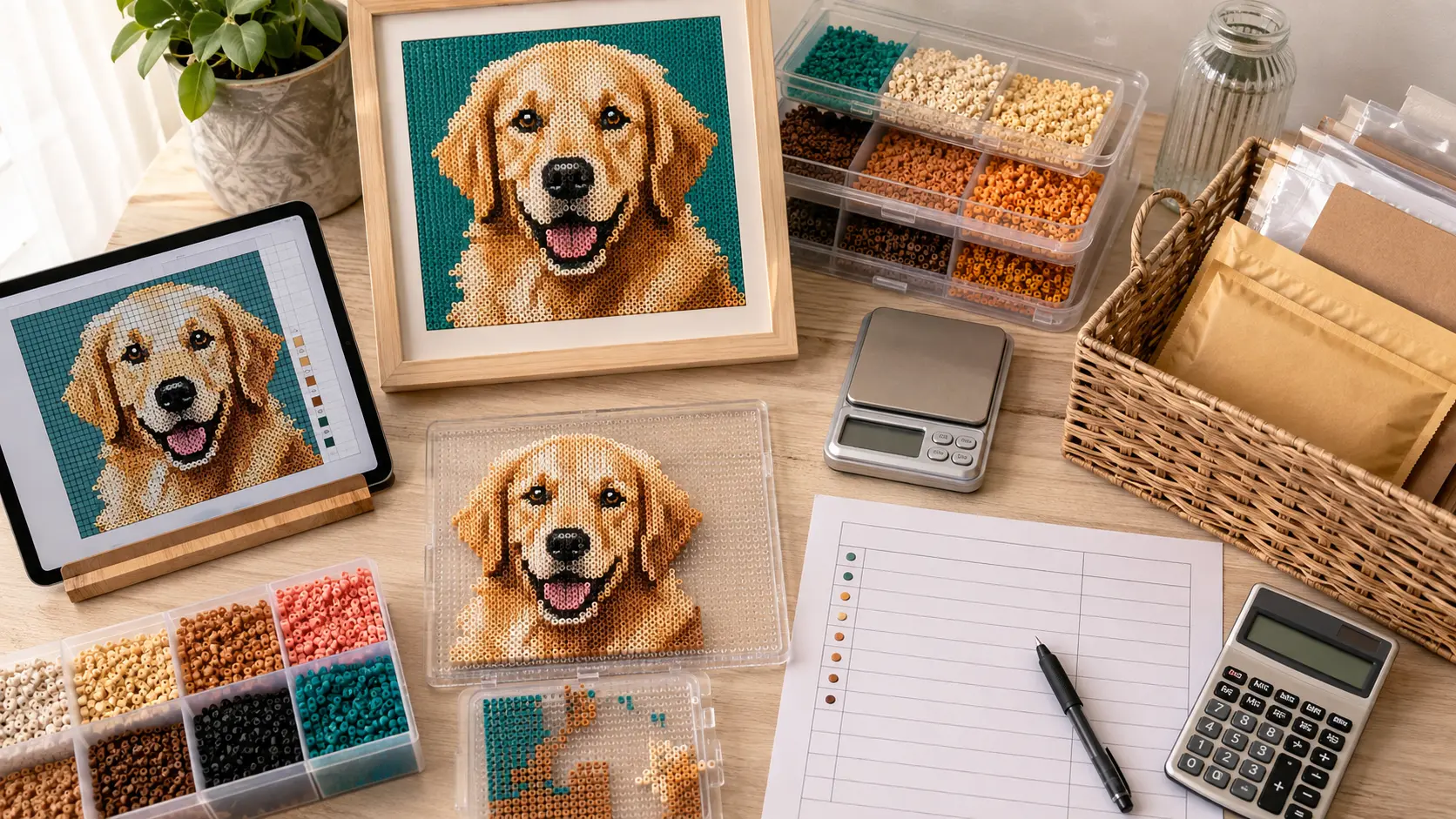
The safest way to price fuse bead art is to build a price floor from materials, labor, packaging, overhead, profit, and selling fees—then test whether the offer delivers enough value for a real buyer. Charging only for the beads makes busy shops look successful while the maker works for almost nothing.
This guide gives you the exact worksheet, formulas, and order-review process to price original sprites, magnets, ornaments, framed portraits, and custom commissions. The examples are planning models, not universal prices or tax advice.
The short answer
Your minimum sustainable price is not “bead count × a random number.” Start with materials + labor + packaging + overhead + desired profit. If a marketplace takes percentage-based fees, divide that target subtotal by 1 minus the expected fee rate. Charge shipping separately or include its full cost in the subtotal before dividing.
Why bead-count pricing fails
Bead count is useful: it tells you the approximate material quantity, physical scale, board count, and some of the placement time. But the same 3,000 beads can become a simple two-color logo or a detailed pet portrait that needs photo review, background removal, palette cleanup, proofing, revisions, careful eyes, framing, and rigid shipping protection. Those orders do not cost the same to produce.
Pricing only by finished dimensions has the same weakness. Size is easy for a customer to understand, so it works well as a menu option, but your internal price still needs to reflect the complexity and finish. Treat size as the customer-facing package and your cost worksheet as the guardrail behind it.
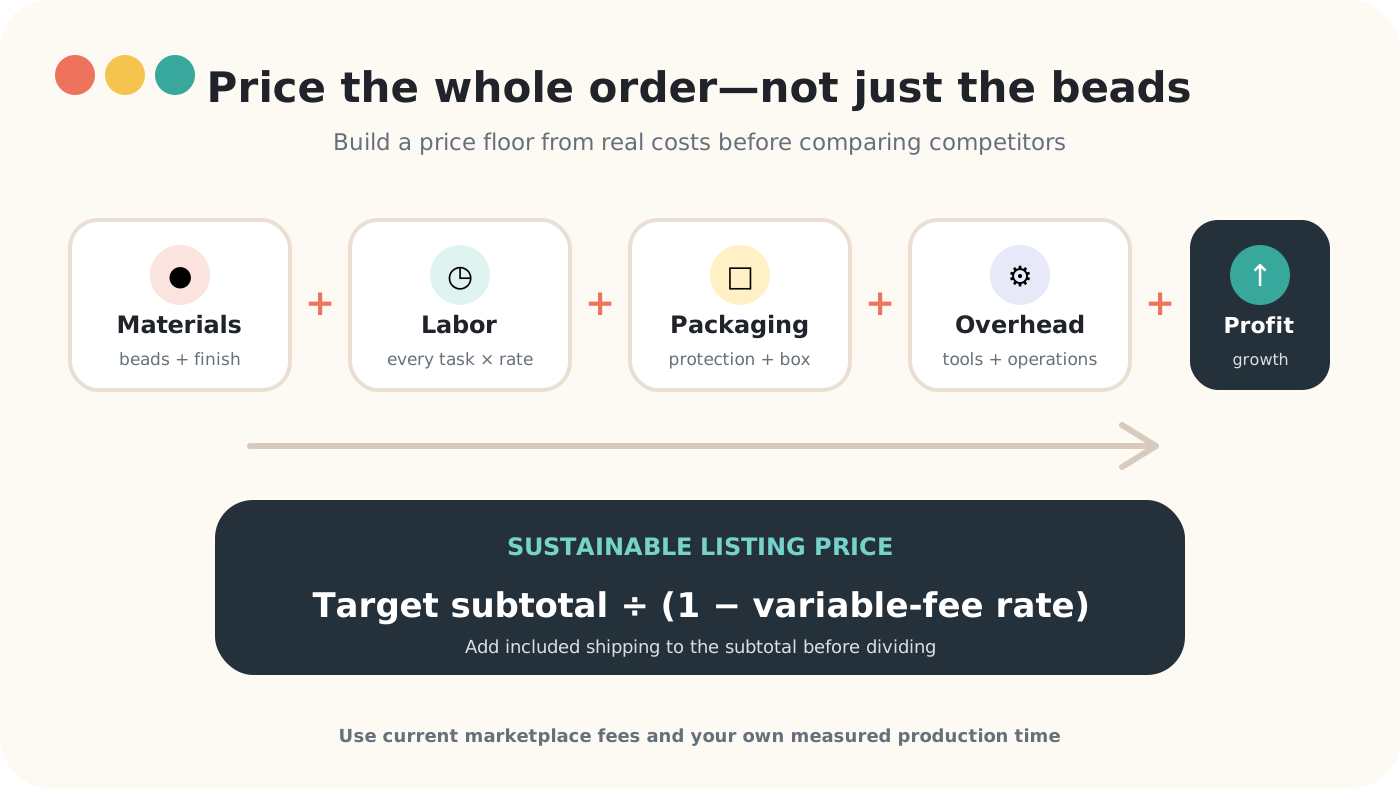
The complete fuse bead pricing formula
Step 1: target subtotal
Materials + labor + packaging + overhead + desired profit
Step 2: price with variable fees
Listing price = target subtotal ÷ (1 − variable-fee rate)
This is a price-floor formula, not a promise that customers will pay the result. After finding the floor, compare the offer with alternatives in the market. If your price is too high for that audience, the answer is usually to reduce complexity, standardize choices, batch production, change the finish, or target a buyer with a stronger reason to purchase—not to erase labor from the worksheet.
Step 1: calculate the real material cost
Count everything that leaves with the order or is consumed making it. For beads, calculate a cost per bead from what you actually paid, including inbound shipping when material. Multiply that cost by the number of each color used, then add a small waste allowance for spills, damaged beads, testing, and remakes.
Cost per bead = bag cost ÷ usable beads in the bag
Pattern bead cost = sum of each color used × its real cost per bead
- Fuse beads by brand, size, and color—specialty colors may cost more than standard colors.
- Backing, frame, mat, adhesive, hardware, magnets, key rings, stands, or display bases.
- Ironing paper or parchment actually consumed, tape, labels, tissue, and protective film.
- Failed-piece allowance based on your own remake rate, especially for large multi-board work.
- Inbound supply shipping that meaningfully changes what the material costs you.
BeadForge gives you an exact per-color count before you quote the order. Restrict the generator to colors you own, decide the board layout, and export the blueprint. That turns a vague supply estimate into a repeatable bill of materials.
Upload the approved image, choose the physical board layout, and use the exact color counts to estimate the materials before accepting the commission.
Calculate a pattern and bead countStep 2: pay for every labor task
Start a timer for the first five examples of each product. Include the invisible work. A 90-minute build can easily become a three-hour order after the quote, proof, color pulling, fusing, finishing, photography, packing, and customer messages are included.
| Labor stage | Time to record | What makers often forget |
|---|---|---|
| Sales and intake | Quote, photo review, questions, options, invoice | Unpaid message threads and unusable reference photos |
| Pattern preparation | Crop, palette, boards, cleanup, proof, revisions | Testing several versions before approval |
| Production | Pull colors, place beads, inspect, fuse, cool, flip | Sorting and repairing weak seams |
| Finishing | Mount, frame, add hardware, clean, quality check | Curing time, replacement parts, and final cleanup |
| Fulfillment | Photograph, wrap, pack, label, hand off | Travel to a carrier or local pickup coordination |
| Administration | Bookkeeping, inventory updates, order records | Small repeated tasks across every sale |
Multiply the total active time by the hourly labor rate you want the job to pay. Profit is not a substitute for labor. Labor pays for the work performed; business profit rewards the risk of owning the business and funds better tools, marketing, growth, and slow periods.
Step 3: add packaging, shipping, and overhead
Packaging
Price the package you actually tested. Flat bead art needs protection from bending and surface pressure, so a mailer may also need rigid board, face protection, corner guards, padding, tape, and a box. Framed work can require more. Weigh and measure the completed test package instead of guessing from the artwork alone.
Shipping
“Free shipping” means the seller pays shipping from the product revenue. Add the expected postage, insurance, and related variable fees to the subtotal when shipping is included. If shipping is charged separately, remember that some marketplaces calculate transaction fees on the shipping amount too.
Overhead
Overhead keeps the shop operating but cannot be assigned cleanly to one piece: irons, pegboards, broken tools, lighting, workspace, insurance, software, bookkeeping, sample pieces, photography gear, website costs, and marketing. Add the expected annual overhead and divide it by a realistic number of annual orders, or apply a consistent percentage and check it against actual totals each quarter.
Worked pricing example: a framed custom pet portrait
Suppose a planned portrait uses about 3,400 beads. These numbers are intentionally hypothetical; substitute your receipts, production time, finish, location, and selling channel.
| Cost | Example calculation | Amount |
|---|---|---|
| Beads with waste | 3,400 beads × average real cost, plus 10% waste | $16.83 |
| Frame and finishing | Frame, backing, adhesive, hanging hardware | $20.00 |
| Labor | 3.25 tracked hours × $20/hour | $65.00 |
| Packaging | Face protection, rigid support, padding, box, label | $7.50 |
| Allocated overhead | Tools, operations, samples, administration | $6.00 |
| Desired business profit | Reserve for risk, growth, and slow periods | $20.00 |
| Target subtotal | Total before percentage-based selling fees | $135.33 |
| Illustrative listing price | $135.33 ÷ (1 − hypothetical 10% fee rate) | $150.37 |
Round intentionally. A clean $150 or $155 menu price is easier to quote than $150.37, but verify that the rounded amount still covers fixed fees and the shipping policy. This is not a recommended price for every pet portrait; it demonstrates how a quote can be traced to real assumptions.
Margin and markup are different
| Measure | Formula | What it tells you |
|---|---|---|
| Profit dollars | Revenue − all costs − paid labor | Money left for the business after the order |
| Profit margin | Profit ÷ selling price | What share of revenue remains as profit |
| Markup | Profit ÷ cost | How much profit was added relative to the cost base |
If an order costs $80 and sells for $100, the $20 profit is a 25% markup on cost but only a 20% margin on revenue. Write the word margin or markup beside every percentage in your worksheet so they do not get mixed up.
Create three customer-friendly price tiers
Buyers should not need to understand your spreadsheet. Give them a small number of clear choices and define what changes the quote. BeadForge’s board layout makes finished scale predictable before production.
| Tier | Good fit | Control the scope |
|---|---|---|
| Small | Original icons, ornaments, magnets, simple sprites | Limited colors, no complex background, standard finish |
| Medium | Single pet or person, shelf art, framed gifts | One subject, defined board count, one proof revision |
| Large | Detailed portraits, multiple subjects, wall pieces | Private quote, deposit, approval milestone, longer lead time |
Add surcharges only for choices that create measurable work: extra subjects, rush deadlines, complex backgrounds, premium frames, unusual palettes, shipping upgrades, or additional proof rounds. Avoid a menu with dozens of tiny fees; a clear package feels more professional.
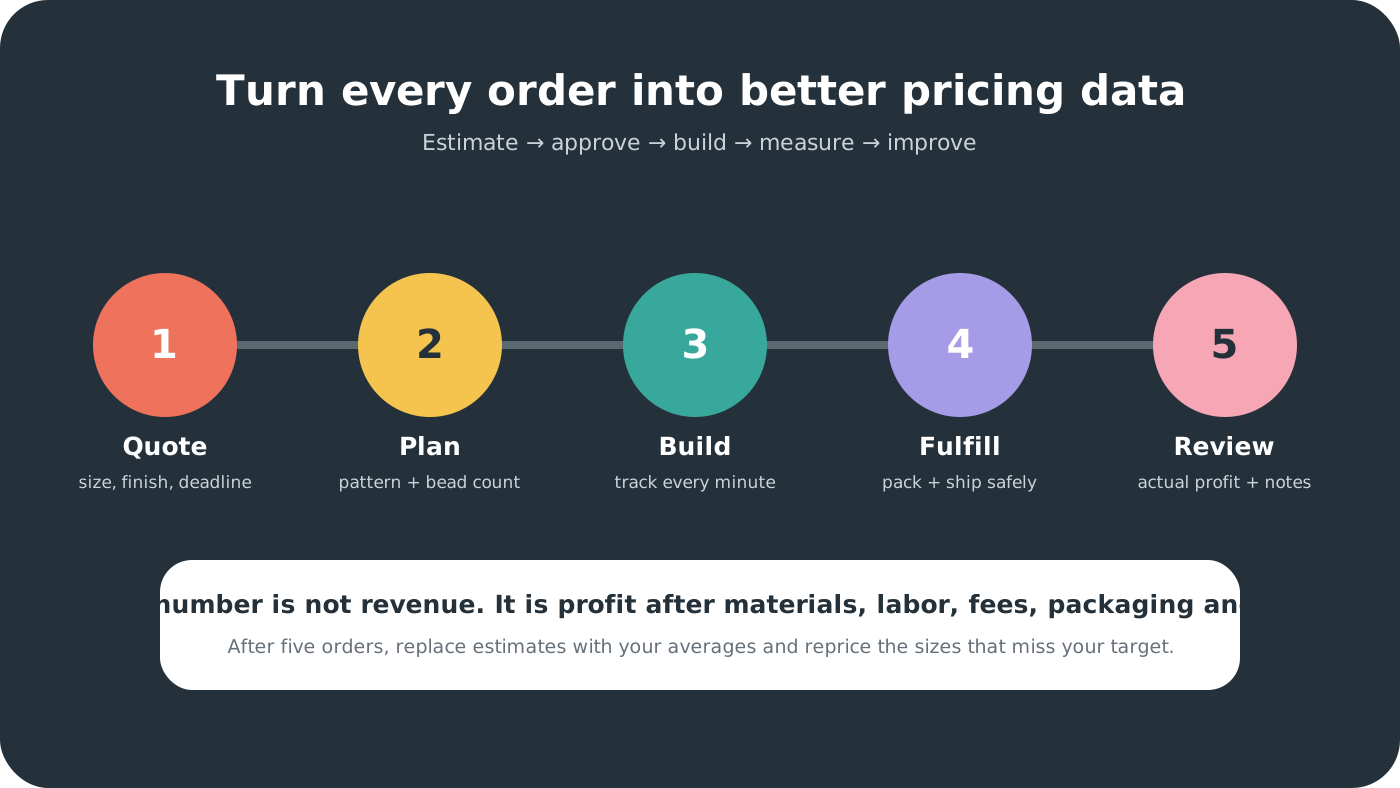
Use a quote-to-profit review on every custom order
- Save the quoted size, finish, deadline, bead count, labor estimate, and expected fee assumptions.
- Lock the approved pattern and clearly state the included revision limit.
- Track active time by stage instead of recording one rough total at the end.
- Record material substitutions, waste, remakes, package measurements, and postage.
- Calculate actual revenue, labor pay, order costs, and profit after delivery.
- After five comparable orders, update the standard time and cost for that tier.
Revenue is the top line, not the win. A $200 order that consumes $80 in supplies and fees plus eight hours of work can be weaker than a standardized $65 product made in a batch. Review profit dollars and profit per active hour together.
Common profit leaks in bead-art shops
- Unlimited proof revisions: define the approval step and charge for work outside the included scope.
- Complex backgrounds: offer solid, removed, or simplified backgrounds as the standard portrait choice.
- Buying every color per order: restrict the pattern to the real stash and price specialty purchases.
- Rush work at normal price: a rush fee should cover schedule disruption, not merely label the order urgent.
- Underpriced shipping: test the complete rigid package, including dimensional weight and insurance.
- Replacing labor with “profit”: pay the maker in the worksheet before counting business profit.
- Discounting without math: calculate the new profit dollars before publishing a sale or coupon.
- Copying competitor prices: you cannot see their material costs, speed, losses, fee settings, or profitability.
When the market will not support your calculated price
The formula can reveal that a product is not viable in its current form. That is useful information. Do not force every design into a commodity price. Change one of the economic drivers while protecting quality.
- Reduce board count, background detail, color count, or finish options.
- Batch original minis, ornaments, magnets, or common color pulls.
- Create reusable original patterns instead of cleaning a new customer photo for every low-price item.
- Raise average order value with stands, frames, coordinated sets, or gift packaging that buyers value.
- Focus custom work on memorials, milestones, weddings, pets, families, and businesses with permission.
- Improve the proof and intake process so poor photos and endless messages do not consume production time.
For the full customer, listing, copyright, photography, packing, and marketplace workflow, read How to Sell Perler Bead Art on Etsy (and Beyond).
Pricing for wholesale and consignment
Retail, wholesale, and consignment are different channels. A store buying wholesale needs room to resell at retail. A consignment shop may keep an agreed share only after the piece sells. Before offering either, confirm that your retail price can support the channel without lowering quality or paying yourself less. Standardized original designs are usually easier to wholesale than one-off photo commissions.
- Set a minimum order quantity or dollar amount that makes batching worthwhile.
- Define payment timing, damage responsibility, returns, display, and unsold inventory in writing.
- Keep suggested retail pricing consistent so direct sales do not undercut a retail partner.
- Do not offer a 50% wholesale discount unless the remaining price still covers production and profit.
Keep records from the first sale
Save receipts, invoices, platform statements, shipping labels, refunds, and an order worksheet that connects income to expenses. The IRS says a business may use any recordkeeping system that clearly shows income and expenses, and its small-business guidance explains that product businesses may need to account for materials and inventory under the rules that apply to them. Ask a qualified tax professional how those rules apply to your location and business.
Useful official references include the IRS pages on business records and Publication 334. Pricing decisions and tax deductions are related in your records, but they are not the same calculation.
Your reusable quote checklist
- Approved subject, crop, background, dimensions, board count, palette, and finish.
- Exact or estimated bead count by color, including specialty-color and waste allowances.
- Frame, backing, hardware, consumables, and tested packaging cost.
- Labor estimate covering intake through fulfillment at your chosen hourly rate.
- Allocated overhead and desired business-profit dollars.
- Current fixed and percentage-based fees for the actual selling channel.
- Shipping policy, package weight, package dimensions, insurance, and rush terms.
- Deposit, proof, revision, cancellation, remake, and completion rules in writing.
- Final review date after delivery so the actual result improves the next quote.
Build a business, not a busy hobby
A strong bead-art brand can teach the craft, provide a useful pattern tool, and help makers turn skill into income without pretending every design is profitable. Price transparently, measure your work, make original products, and let the numbers tell you which offers deserve to grow.
Sources and update standard
This guide was reviewed against Etsy’s current Fees & Payments Policy and its seller guidance on pricing for profit, plus IRS recordkeeping guidance. Etsy’s policy currently lists a 6.5% transaction fee while payment processing, advertising, currency, regulatory, and other possible charges depend on the order and seller. Verify the live policy and your own payment account before quoting. BeadForge is independent and is not affiliated with or endorsed by Etsy, Perler, Hama, Artkal, or Nabbi. This article is general education, not legal, tax, or financial advice.
Frequently asked questions
How much should I charge for Perler bead art?
There is no honest one-price answer. Calculate the beads and finishing materials, all labor, packaging, overhead, desired business profit, and current selling fees. Then compare that sustainable price with what the target buyer values. If the market will not support it, simplify the product instead of quietly removing your pay.
Should I price bead art by the bead or by the hour?
Use both measurements internally, but do not rely on either alone. Bead count estimates material use and scale; tracked hours reveal the real labor. Your final price also needs finishing materials, packaging, overhead, risk, profit, and channel fees.
What hourly rate should I use for handmade bead art?
Choose a rate that reflects the work and your local business goals, then test it against actual production time. Include pattern cleanup, customer messages, bead sorting, placement, fusing, finishing, photography, packing, and handoff—not only the minutes spent placing beads.
How do I include Etsy fees in my price?
Build a target subtotal from costs, labor, overhead, and profit, then divide it by one minus your estimated percentage-based fee rate. Add fixed per-order costs separately where appropriate. Etsy has several possible fee types, so use its live fee policy and your own payment, advertising, currency, and country settings rather than copying an old percentage.
Is selling Perler bead art profitable?
It can be, especially when the offer is original, personalized, repeatable, and priced from measured time. Tiny low-priced pieces often struggle because messages, packaging, and order handling can cost more than the beads. Custom portraits, event pieces, original decor, and useful bundles can support stronger order value.
How much profit margin should handmade bead art have?
Set a margin that funds mistakes, new tools, slower weeks, and growth after paying labor and all order costs. Margin is profit divided by selling price, while markup is profit divided by cost; they are not interchangeable. Test a few target margins in your worksheet and use the one your market and process can sustain.
Ready to make your own pattern?
BeadForge turns any image into a printable fuse bead pattern with bead counts and pegboard sizing — free, in your browser, no signup.